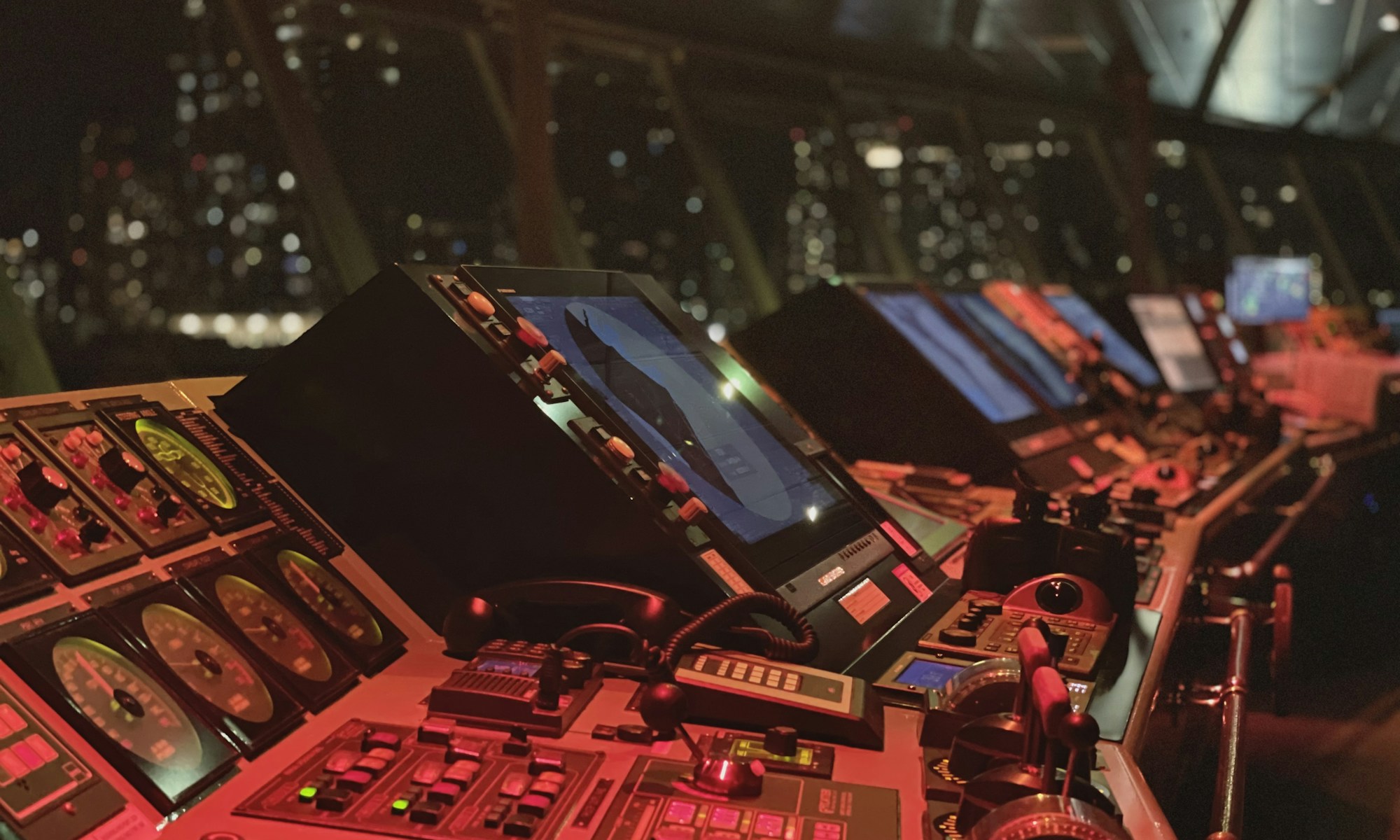
The Problem
Running a mid-market company is a specific kind of hard.
You are big enough that everything is complicated, but not big enough to have the infrastructure that makes complexity manageable.
You are supposed to be focused on growth — but Friday comes around and the needle hasn't moved. Reality is dealing with whatever crisis appears in your office today and trying to do the job you were hired for in whatever time is left over. It's exhausting, when it even works. All too often, you fight just to tread water.
You told yourself you'd spend the weekend getting a handle on things. But you don't need more hours, a longer weekly ELT meeting, or more spreadsheets from the field. You need tools that handle the influx, identify the problems early, and point your attention to where it adds the most value. Did you know mROI on social spend is down 8% this month? Yeah, neither did the CMO. Meanwhile, code review for the Q2 launch that will help you make plan is delayed. If you and the CTO get on that today, you might just avoid another launch delay and keep the board off your back.
Leaders govern reactively.
Executives and boards receive a monthly package curated by analysts. When something goes wrong, they find out in the meeting where it is already a crisis.
Initiatives break down, and accountability wanes.
Problems that were smoldering deep in the business surface as five-alarm fires. The CEO — who should have the fullest picture — is usually the last to know.
Information assembly is the CEO's weekend job.
Re-reading emails before 1:1s. Building board decks from scratch every quarter. Sifting through KPIs to feel comfortable that things aren't about to melt down. All of it manual. All of it taking time that should be spent leading.
Boards and investors depend on management self-reporting.
Without an independent view into the business, boards calibrate risk from what management chooses to surface — often finding out about problems months after the signal was already in the data.
Separate modules that work together — freeing leadership to do what it's supposed to do. Lead.
KPIs monitored across every function, 24/7 — so nothing drifts quietly in the wrong direction.
Centralized place that brings it all together. The browser window that's never closed.
The Gap
Every function has a system built to tell its leader what's happening. Salesforce, NetSuite, Adobe, Workday, Monday, and Jira all keep things moving fast and drive accountability.
Why are you still using a Moleskine and a dated spreadsheet from finance?
No sales leader would run a sales team without a CRM. Why would you run a company without Bridge?
The Framework
Stop reacting, start delivering.
Distilled from years of operating experience across PE-backed mid-market companies, we've focused on seven problem areas. Get clarity on what is and isn't happening in each, and watch the stress level fall while the right work accelerates. The CEOs who get where they're going are the ones who monitor all seven — all the time.
Are we aligned on the end-goal?
If every director isn't 100% aligned on the goals and timeline to achieve them, there is no future. Make sure that everyone agrees on the where and the when — only then can you build the how and the who. Without it, the executive team fails.
How are you going to get there?
Identify the three levers that move the business. Break each into specific deliverables, assign a name and a deadline to every one. A vision without this level of specificity is not a plan — it is a hope.
Can your direct reports actually execute the plan you just built?
The honest answer to this question is the most important decision a CEO makes. Make changes before the plan requires it, not after.
Where are the smoldering problems that haven't surfaced yet?
Clean the forest floor before it burns. Set early warning systems so issues are seen while they are still fixable — not when they're a five-alarm fire.
Are we doing the things that we need to do?
Have a clear plan for the biggest initiatives, and know in near-real time where you're on / ahead / behind schedule. Track responsibility. Separate the useful from the annoying, and manage what you need from them, and what they need from you.
Do you truly understand your financial model?
Not the summary — the mechanics. Which levers move revenue, margin, and cash. The CEOs who know their model cold make better decisions faster and almost never get surprised by a quarter.
Is the board adding the right kind of value?
Boards are most useful when they engage at the right level — too high and you get no help, too low and they micromanage. Build meetings at the right level, without spending weeks on deck prep.
Get all seven under control. Things calm down. You can actually run the business.
Bridge is the platform built to keep all seven in view — continuously, not just at the end of the quarter. That's what lets leadership act deliberately instead of react to whatever surfaced last.
How It Works
Your company already produces the information. Bridge makes sense of it.
Bridge connects to the systems your teams already use, combines that data with your plans, initiatives, priorities, and leadership inputs, and organizes it around how the business is actually being run.
It doesn't create another reporting exercise. It creates meaning from the information your organization already produces.
- Connects your systems
- Organizes around priorities
- Surfaces what matters
The Platform
One operating picture.
Nine connected views.
Each module answers a question leadership is already trying to answer — connected around a shared picture of what matters.
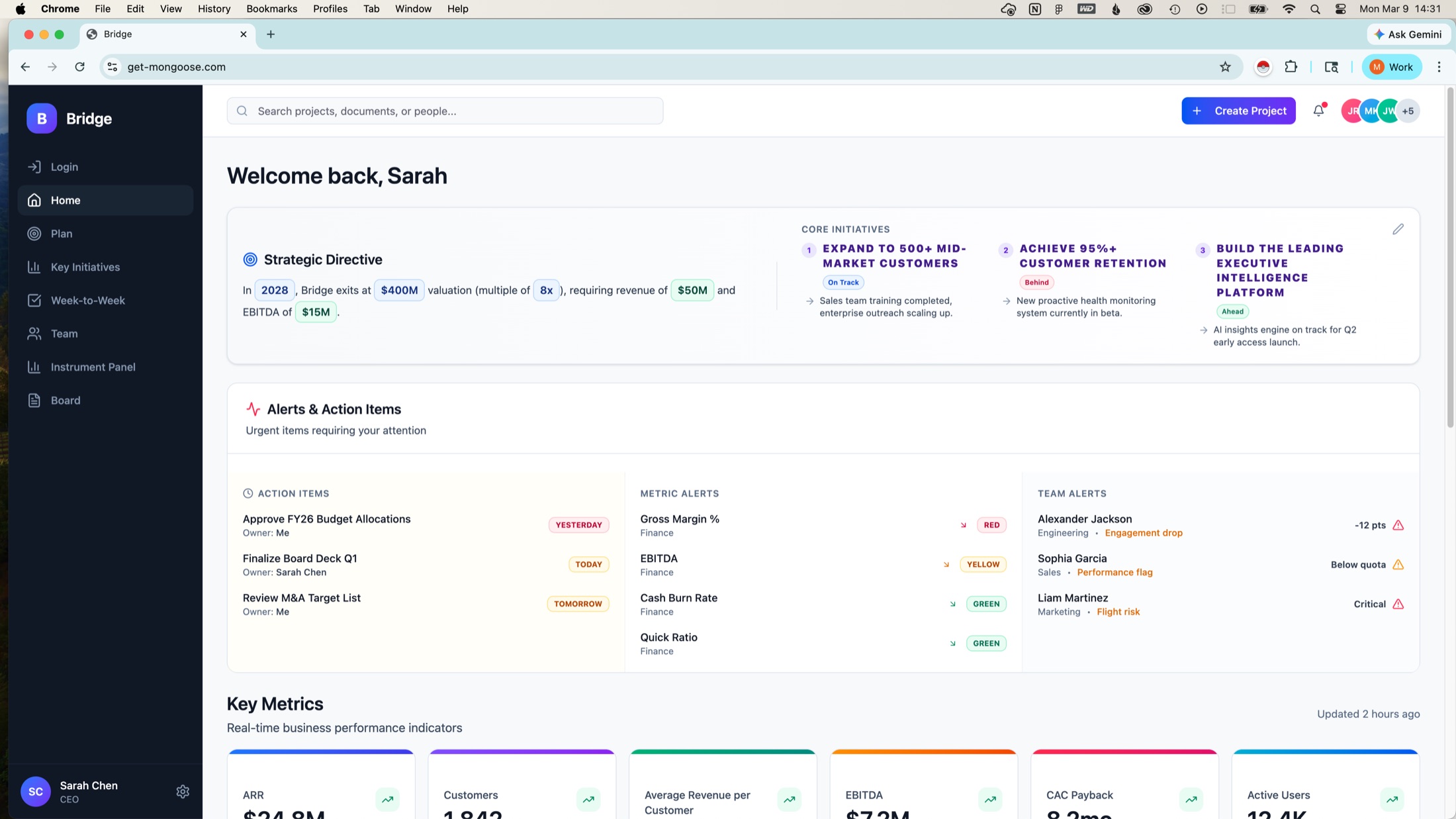

“I open Bridge, and my blood pressure drops ten points.”
Built around the CEO.
Useful to everyone around them.
Stop assembling.Start leading.
CEOs today spend too much time reacting to their inboxes and not enough time leading the work that matters.
- →Constantly monitor hundreds of KPIs across the business.
- →Walk into every 1:1 with a fully-prepared brief and every management team meeting with the roundtable completed as a pre-read.
- →Know when initiatives are drifting before they become board conversations.
- →Generate your board deck in one click, not two weeks of manual assembly.
- →Force alignment across your executive team without endless meetings.
From reactive oversight toinformed governance.
Board members are often the last to know when something goes wrong — because the only information they receive is what management chooses to share, once a quarter.
- →View real-time KPIs across the business — not just what's in the board deck.
- →Access materials, track reading progress, and vote before meetings begin.
- →See whether strategic initiatives are on track — independently, not from management's summary.
- →Submit comments before meetings, making governance time more productive.
- →Maintain a complete, automatic record of votes, decisions, and governance actions.
Portfolio visibility beyondthe weekly calls.
PE investors juggle portfolio companies and are almost entirely dependent on management self-reporting. Bridge provides an independent, always-on view without creating burden for your management teams.
- →Continuous KPI visibility across every business you oversee — not just quarterly packages.
- →See whether key initiatives are executing as planned — in real time, without a status call.
- →Identify management team gaps before they become retention events.
- →Reduce check-in burden on portfolio CEOs by reducing the need for status calls.
- →Build a consistent operating framework across every company in your purview.
Clarity on what matters.Accountability for what's yours.
The best executives don't just execute — they know exactly what they own, why it matters, and how it connects to the plan. Bridge makes that clarity explicit, shared, and permanent.
- →Know your role in the plan — not just your job description, but what you specifically have to deliver for the company to win.
- →Understand what the CEO and board are focused on, so your priorities are never out of sync with theirs.
- →Get visibility into your teams, seeing which are working well and which need help.
- →Own your deliverables in a shared system — so accountability is clear without micromanagement.
- →Walk into every 1:1 with your CEO already aligned on context, so the conversation is about decisions, not updates.
See what changeswhen you sit at the controls.
Request a Demonstration
Bridge is built for CEOs and leadership teams running complex mid-market businesses. If you're spending too much time assembling information, chasing updates, or discovering problems later than you should, we'd like to show you another way.
No demo treadmill. No automated sales sequence. We'll show you Bridge, learn how you're running the business today, and see whether there's a fit.
We'll be in touch.
Expect a response within one business day.